

Break my habit
This module gives you practical tools to interrupt urges and stay in control when it gets hard.
Module 3 of 5 · ~20 min · Your pace
This module is practical. It gives you specific things to do, not just things to understand.
Some of it might feel uncomfortable. That’s okay, go at your own pace. The crisis page is always available if you need it.
In this module, we will take a closer look at your high-risk moments, those moments when you feel like searching, viewing, or asking for images or videos that sexualise children or other violent sexual content. You will learn how to notice early signs and manage urges when they show up.
By practising regularly, you can learn new, healthier, and safer ways to respond to situations where you may have previously felt the need to search for and click on harmful sexual content.
My high-risk moments
A high-risk moment is anytime when you’re likely to search, view or ask for images or videos that sexualise children or other violent sexual content, even if you didn’t plan to.
When are your high-risk moments?
Tap one or more that fit your experience:
Early warning signs
Early warning signs are about what starts shifting inside you, the subtle changes that show up before an urge gets strong. Noticing these early gives you more room to choose differently.
Below, you’ll map yours across four areas: your feelings, thoughts, behaviour, and body.
🌊 Early signs in my feelings
What emotions tend to show up just before an urge? Feelings are often the first signal that something has shifted.
Pick everything that fits.
💭 Early signs in my thoughts
What does your mind start telling you? These are the automatic thoughts that can push you further toward acting.
Pick everything that resonates.
🚶Early signs in my behaviour
What do you start doing differently, even without fully realising it? Small shifts in behaviour can be early clues.
Choose the ones that feel familiar.
🧍Early signs in my body
What do you notice physically? Your body often responds before your conscious mind catches up.
Choose the ones that feel familiar.
Breaking the path
Great job, you have already started breaking the harmful path by being here!
Here’s how the cycle might look in practice:
You’re bored → you open your phone → you open a certain app → you search for something harmful → you click on the content
Each arrow is a moment where you could have gone a different way.
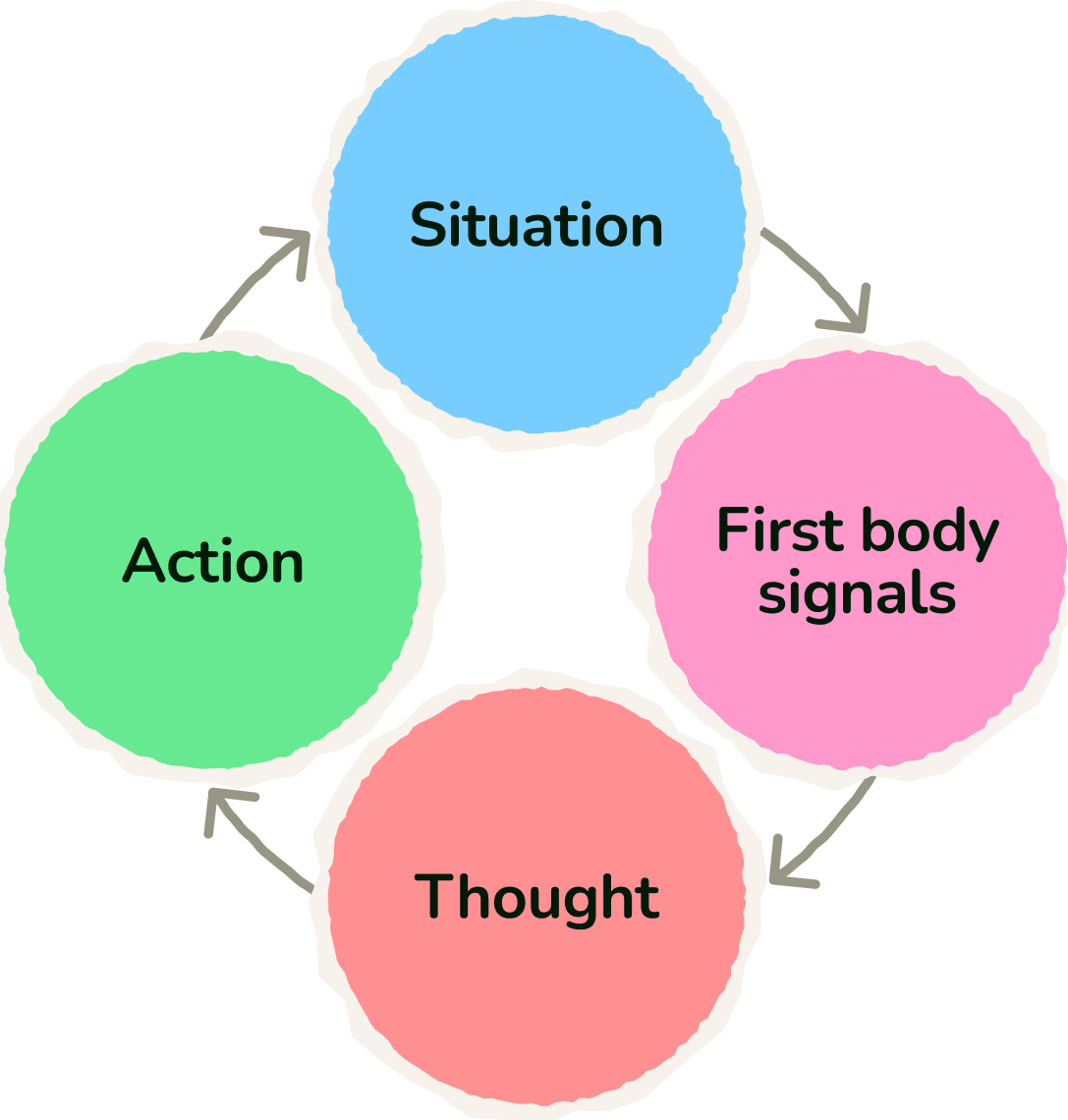
You can interrupt the cycle at 4 points:
The situation — where you are, what’s around you, what just happened
The first body signals — the earliest physical shift: tension, restlessness, arousal
The thought — the idea your brain offers to justify the next step
The action — opening an app, typing a keyword, clicking
Which step can you interrupt?
You don’t have to start big, you are in control! Even small steps can help break the path to harmful sexual behaviour.
Select the ones you feel ready to work on:
🔧 Changing the situation
Changing your environment can reduce how often urges show up and how strong they feel.
Pause
When you notice the early warning signs, try this tiny exercise, which can give you the space to choose differently.
STOP technique
Stop
Freeze what you’re doing. Don’t follow the urge.
Take a break
Remove yourself from the situation, take a deep breath and try to clear your head.
Observe
Notice your emotions, thoughts, and surroundings. What’s happening right now?
Proceed mindfully
Ask yourself: will what I’m about to do make this better or worse? Then act with that in mind.
Handling a strong urge
Sometimes an urge just hits, hard and fast. It’s a strong feeling that pushes you toward doing something right now, without thinking. But urges always follow the same pattern: they rise, peak, and fall. Every time, even the biggest ones. You don’t have to stop the urge, you just have to wait it out.
An urge is like an itch
One way to handle strong urges is to practice staying with a feeling without reacting, just observing it until it fades on its own.
Here’s a simple exercise:
Just notice it
Don’t scratch.
Feel what happens in your body
The tension, the impatience, the urge getting stronger.
Instead of reacting, just observe
watch the urge rise, reach its peak, then slowly get smaller.
Focus on your breathing while you wait
Notice
The itch didn’t disappear because you scratched it. It faded because you waited it out.
This shows you something important: even when an urge feels overwhelming, it doesn’t control you. You can ride it like a wave instead of being pulled under. Even the biggest waves eventually calm down, and with practice, you get better at staying balanced.
Practical tools
Quick tools to help you manage difficult feelings.
Catching the thought
Your brain might give you quick thoughts that push the urge forward. Learning to notice and replace them helps you stay in control.
Common thoughts, and what to replace them with
Tap each one to see the alternative
This urge will pass.
Someone real is being harmed.
I can pause for 30 seconds.
I will know, and I want to feel better.
I need comfort, not this.
When one of these thoughts shows up, try responding with:
- This thought has shown up before.
- I don’t have to decide right now.
- This urge will peak and pass.
- Doing nothing is still a choice.
Changing what happens next
When you get the urge, your brain is usually asking for something to change: your mood, your energy, or your attention.
Pick at least 2 things to try
Choose what feels doable in real life
The next section is different from the last ones. Instead of looking at your own patterns, you’ll be looking at the impact: what happens to other people. Take it at your own pace.
Empathy exercise
This part looks at what happens beyond the screen when harmful sexual behaviour or content that sexualises children is involved.
The goal is to look clearly at the impact and understand the full picture.
Harmful sexual behaviour online can feel private or distant.
You might start by noticing what changes for another person when certain actions happen.
Explore each situation
Tap to see the impact
What this means:
⚠ The image/video exists because a child was sexually exploited.
🔄 The images or videos continue circulating and remain active online.
👁 The child cannot control who sees their body.
🧠 Repeated viewing makes the brain return to similar content and makes it feel “normal” and “acceptable” when it’s not.
What this means:
🔄 Harmful behaviour can start to feel normal and acceptable.
📈 You keep searching for more extreme harmful content over time.
👥 Group pressure can make it harder to leave.
What this means:
🚫 The child cannot consent.
📷 Harmful sexual or violent content is spread beyond control.
⚠ Harm continues even after the message is sent.
What this means:
🚫 Violence and sex are being mixed together. This increases the chance of crossing someone’s boundaries.
🧠 Watching sexualised violent content make your behaviour feels “normal” and “acceptable”, when it’s not!
❗ Real children and people are hurt when violence and aggression becomes a part of sexual behaviour.
The important part is understanding what happens when harmful sexual behaviour occurs.
You don’t have to do this alone
Some people find a programme like this is enough. Others find it easier with someone to talk to.
You don’t need the right words to ask for support.
You don’t have to explain everything. You can just say you’ve been struggling with something and want to talk. That’s enough.
Support is available whenever you’re ready. ➡️ Get support.
You now have tools, not just understanding. Things you can actually use the next time an urge shows up.
Good job and keep going!
Key takeaways
You can interrupt your cycle at 4 different points. You do not have to wait until the last one. Urges always peak and fade. Every single time. You just have to wait them out. Having a plan before the urge hits makes it much easier to handle it.
If you close now, come back to Module 4. It shifts direction: less about the problem, more about the life you want to live.

Module 4
Redirection of my life
~20 min reading
You do not need to think during this. Just follow one step at a time. Your body will shift.
Cold water
Go to a tap now. Run cold water over your wrists or splash it on your face. As cold as you can get it.
No tap nearby? Hold something cold. A drink, anything from the fridge.
Keep going.
Cold water. Do not stop yet.
Squeeze everything
Squeeze every muscle in your body. Make fists. Tighten your arms. Pull in your stomach. Squeeze your legs. Scrunch your face.
Everything at once. As hard as you can.
Hold for 10 seconds. Then let everything go completely.
Squeeze. Hold it.
Every muscle. As hard as you can.
One breath
Just one breath. Follow the circle.
Two short sniffs in through your nose.
Then one long slow breath out through your mouth.
One breath only.
Body scan
Start at the top of your head. Move slowly down to your feet.
Wherever you feel tension, let it go.
Just notice. Then release.
Your body just went through four steps designed to shift your nervous system. That is real.
Cold water activated your dive reflex and dropped your heart rate. Squeezing burned through the physical tension. The breath slowed your nervous system. The scan released what was left.
The feeling that brought you here needed your body in a high-alert state. It does not have that anymore.
Come back to the room you are in.
This takes about 2 minutes.
You just need to look around and notice things.
You just used five senses to bring yourself back into this moment. That is what grounding does.
When a strong feeling pulls at you, your brain loses track of where and when you actually are. Grounding works by giving your brain real information from your senses right now.
The feeling that brought you here was pulling you somewhere else. You just came back.